Sunday, November 27, 2022

Color Scheme - Part 2: Split Complementary, Triadic, Square, & Rectangle


 In color theory, various color schemes can significantly influence the mood and visual impact of a design. In this blog we will continue reviewing color schemes.

4. Split Complementary: A split complementary scheme includes one dominant color and the two colors directly adjacent to the dominant color's complement. This creates a more nuanced color palette while retaining contrasting colors' benefits. The split complementary color scheme can be challenging to balance because, unlike analogous or monochromatic color schemes, all colors provide contrast (similar to the complementary scheme). The positive and negative aspects of the split complementary color model are that you can use any two colors in the scheme and get great contrast, but it can also be tricky to find the right balance between the colors. As a result, you may end up playing around with this one to find the right combination of contrast.


5. Triadic: Triadic color schemes offer highly contrasting color schemes while retaining the same tone. Triadic color schemes are created by choosing three colors that are equally placed in lines around the color wheel. Triad color schemes are useful for creating high contrast between each color in a design, but they can also seem overpowering if all of your colors are chosen from the same point in a line around the color wheel. To subdue some of your colors in a triadic scheme, you can choose one dominant color and use the others sparingly, or simply subdue the other two colors by choosing a softer tint. 


6. Square: The square color scheme uses four colors equidistant from each other on the color wheel to create a square or diamond shape. While this evenly spaced color scheme provides substantial contrast to your design, it’s a good idea to select one dominant color rather than trying to balance all four.


7. Rectangle: Also called the tetradic color scheme, the rectangle approach is similar to its square counterpart but offers a more subtle approach to color selection. As you can see in the diagram, while the blue and red shades are quite bold, the green and orange on the other side of the rectangle are more muted, making the bolder shades stand out.


If you build a color scheme with five colors, you don’t have to use all five. Sometimes just choosing two colors from a color scheme looks much better than cramming all five colors together in one graphic.

Thursday, October 27, 2022

Color Scheme - Part 1: Monochromatic, Analogous, & Complementary


In color theory, understanding color relationships is crucial for effective design and art.

1. Monochromatic: Monochromatic color schemes use a single color with varying shades and tints to produce a consistent look and feel. Although they lack color contrast, they're often very clean and polished. You can also easily change the darkness and lightness of your colors. Check out all the monochromatic colors that fall under the red hue, a primary color.


2. Analogous: Analogous color schemes are formed by pairing one main color with the two colors directly next to it on the color wheel. You can add two more colors (found next to the two outside colors) if you want to use a five-color scheme instead of just three. Analogous structures do not create themes with highly contrasting colors, so they're typically used to create a softer, less contrasting design. For example, you could use an analogous structure to create a color scheme with autumn or spring colors. This color scheme is excellent for warmer (red, oranges, and yellows) or cooler (purples, blues, and greens) color palettes like the one below.


3. Complementary: A complementary color scheme is based on two colors directly across from each other on the color wheel and the relevant tints of those colors. The complementary color scheme provides the most significant amount of color contrast. Because of this, you should be careful about using complementary colors in a scheme. It's best to predominantly use one color and the second color as the accent color in your design. High contrast helps you highlight important points and takeaways.


Tuesday, September 27, 2022

The Meaning of Color


The meaning of color extends beyond mere aesthetics, influencing our emotions, perceptions, and behaviors. Each hue conveys unique symbolism, from warmth and energy to calmness and sadness, shaping our experiences and interactions in profound and often subconscious ways.

  • Red — is typically associated with power, passion, or energy and can help encourage action on your site.
  • Orange — joy and enthusiasm, making it a good choice for positive messaging.
  • Yellow — happiness and intellect, but be wary of overuse.
  • Green—often connected to growth or ambition, green can help create the sense that your brand is on the rise.
  • Blue — tranquility and confidence, depending on the shade — lighter shades provide a sense of peace, and darker colors are more confident.
  • Purple — luxury or creativity, mainly when used deliberately and sparingly on your site.
  • Black — power and mystery, and using this color can help create necessary negative space.
  • White — safety and innocence, making it a great choice to help streamline your site.


Cultures experience color differently.

Cultural contexts significantly shape color perception and symbolism, as various societies attribute distinct meanings to colors. While red typically symbolizes passion or power in the United States, it's considered a color of mourning in South Africa. Sometimes, entire color schemes are more or less palatable depending on the country and culture. Sukrahj, a graphic designer, is working on a logo for an India-based company that wants to use bright magenta and navy. That combination of colors "doesn't necessarily land in the U.S.," she says, "the same way it would in India." Understanding these differences enriches our appreciation of color's impact on communication and emotional expression across cultures.

Color Theory: Hue - Tint, Shade and Tone


Hue, tint, shade, and tone are essential concepts in color theory, shaping how colors interact and influence visual perception.

Hue refers to the pure color of an object, determined by its wavelength in the visible light spectrum. It is the characteristic that distinguishes one color from another, such as red, blue, or green. Hues are often represented on the color wheel, which organizes colors based on their relationships and positions.


Tint is created by adding white to a hue, lightening it and producing softer variations. For example, adding white to red creates pink. Tints are often used in design to convey gentleness or warmth, evoking feelings of calmness or sweetness.

Shade is produced by adding black to a hue, darkening it and resulting in deeper variations. For instance, adding black to blue creates navy. Shades can add drama and depth to a color palette, enhancing contrast and emphasizing certain elements in a composition.

Tone is achieved by adding gray (a mixture of black and white) to a hue, which alters its intensity without significantly changing its basic color. This process results in a more muted or subdued version of the original hue. For instance, adding gray to red can create a sophisticated or complex tone, suitable for various artistic contexts.


Understanding these concepts helps artists, designers, and anyone working with color create visually appealing compositions and effectively convey emotions and messages through their work.


Saturday, September 24, 2022

Color Theory: Traditional Color Theory


Traditional color theory forms the foundation of color relationships, focusing on primary, secondary, and tertiary colors. 

Primary colors—red, yellow, and blue—cannot be created by mixing other colors, making them the fundamental building blocks in design. These colors act as “parent” colors, offering a base for creating a variety of shades, tones, and tints. While primary colors are essential, designers are not limited to using only them. For instance, mixing primary colors can produce secondary colors like orange, purple, and green. 


These secondary colors are made by combining two primary colors, following the basic rules: 

Red + Yellow = Orange

Blue + Red = Purple

Yellow + Blue = Green

The combinations depend on using the purest forms, known as hues.

Tertiary colors come from mixing a primary color with a neighboring secondary color on the color wheel, resulting in colors like red-orange (vermillion) or blue-green (teal). 

It’s essential to remember that not every primary-secondary combination works harmoniously; for example, mixing red and green yields a brownish color instead of a distinct tertiary color. Tertiary colors expand the palette beyond primary and secondary shades, adding complexity to design.

Red + Purple = Red-Purple (magenta)

Red + Orange = Red-Orange (vermillion)

Blue + Purple = Blue-Purple (violet)

Blue + Green = Blue-Green (teal)

Yellow + Orange = Yellow-Orange (amber)

Yellow + Green = Yellow-Green (chartreuse)


The color wheel, a circular diagram, helps visualize the relationships between these 12 main colors—primary, secondary, and tertiary—while also including hues, tints, tones, and shades.

 The concept of the color wheel dates back to Isaac Newton’s work in 1704. Newton’s lab-based study of pigments contrasts with Johann Wolfgang von Goethe’s focus on perception and experience, highlighting early debates about primary colors. The traditional color wheel remains a valuable tool for choosing color schemes, illustrating how colors relate and combine based on the spectrum of visible light.

Thursday, July 14, 2022

The Elements of Art


Have you ever wondered what makes a painting visually interesting? The answer lies in the elements of design, the fundamental building blocks that artists use to create any artwork. They're like the alphabet of art – once you understand them, you can use them to create anything you imagine, regardless of the medium.

Shape: This encompasses both geometric shapes (circles, squares, triangles) and organic forms (free-flowing shapes like blobs and curves).

Line: A simple definition – a continuous path connecting two points.

Size: The relative magnitude of an element – is it large, small, or somewhere in between?

Direction: The overall positioning of objects within your artwork – vertical, horizontal, or diagonal.

Texture: The way something feels, or the illusion of how it would feel if you could touch it.

Color: What brings vibrancy and life to your artwork. It can be used to create emotions, establish a mood, and guide the viewer's eye around the composition. From bold contrasts to subtle harmonies, color choices play a significant role in shaping the overall impact of your art.

By understanding and manipulating these elements, you gain the power to create captivating art. 

Sunday, October 3, 2021

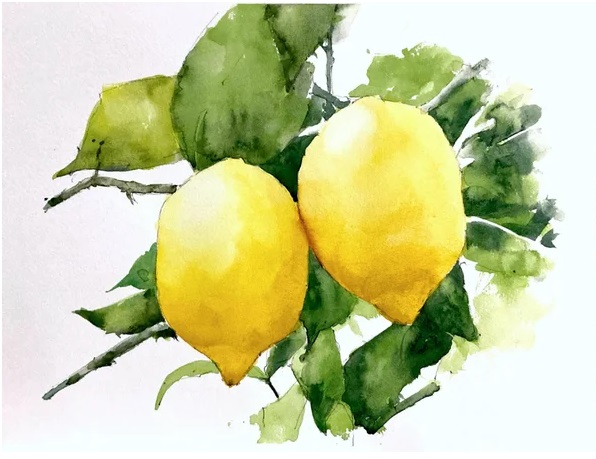
Watercolor Tutorial: Lemons


Lemon Watercolor Tutorial

Painting a lemon in watercolor might seem challenging, but you can do it with just a few colors and a little patience! Lemons have such a bright, cheerful yellow that they’re perfect for watercolor practice. Follow along with this demo, and you’ll see how a couple of tricks can make the process easier.


Step 1: Draw the Outline

Start by creating a pencil drawing of your lemon. If you’re not confident in your freehand skills, use a grid. Divide your reference photo and your watercolor paper into quarters. This will help you match the proportions without complicated calculations. Be mindful when using watercolor; pencil lines can show through since the paint is transparent. To avoid this, use light dots at the grid intersections, which won’t be noticeable under your paint.


Step 2: Make Test Swatches

Before diving into the painting, create some test swatches of your colors on a piece of scrap paper. Test your lemon yellows, leaf greens, and shadows. This step helps you get a feel for how your colors will look on the final painting, and it also gives you confidence when you start to paint.


Step 3: Start Painting Your Lemon

Begin by laying down your lightest yellow for the lemon’s main body. Start with a soft wash of lemon yellow, letting the paint flow naturally to capture the smooth roundness of the fruit. Once dry, you can go back in with a slightly darker yellow, like a touch of cadmium yellow, to add shading where the light doesn’t hit.


Step 4: Paint the Leaves

For the leaves, mix lemon yellow and cobalt blue with a tiny bit of black to create a rich, dark green. Apply this to your leaves, using the mix for the shadows to add depth. Remember to observe how the light hits both the fruit and the leaves so that your painting looks convincing.


Final Step: Touches and Details

Once your painting has dried, go back in for the final touches. Strengthen the shadows with another layer of color, and add tiny details like the lemon’s texture or veins in the leaves.


Watercolor is all about layering and patience—let each layer dry before adding the next! Most importantly, enjoy the process and be proud of your work. You’re learning and improving with each brushstroke. Happy painting!